How receivables financing works

Illustration facture croissance

What is receivables financing?

Receivables financing is the primary short-term funding solution for B2B companies. The receivables financing provider – also known as the factor – purchases your customer invoices and advances the corresponding funds, enabling your business to strengthen its cash position. This solution is exclusively intended for B2B companies, regardless of invoice volume.

Receivables financing can unlock up to two months of revenue, initially tied up due to agreed payment terms (which in France can reach up to 60 days end of month). It significantly improves your working capital requirement (WCR) and acts as a strategic lever by converting trade receivables into immediate cash flow.

What is the principle of receivables financing?

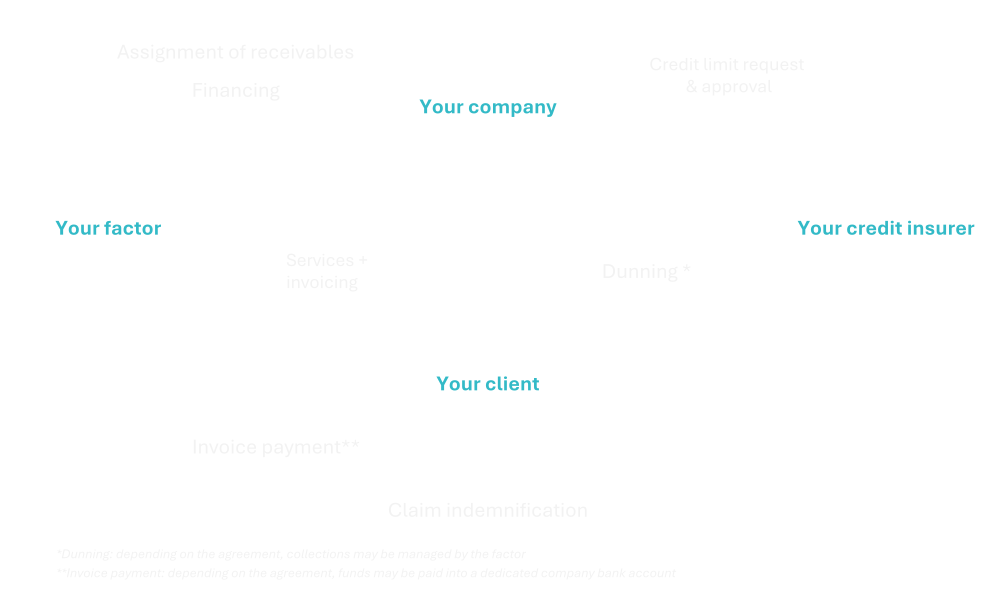
There are several forms of receivables financing: classic, undisclosed, off-balance sheet, reverse, notified but un-managed, spot financing, and more. The standard arrangement – known as full factoring – operates as follows:

(1) The company issues a customer invoice.

(2) It assigns the invoice to the factor.

(3) The factor notifies the debtor and advances a cash payment (typically up to 95%).

(4) At maturity, the customer pays the factor directly.

(5) The factor remits the remaining balance to the company, after deducting fees.

Some agreements also include accounts receivable management services (invoice matching, collections, reminders, and debt recovery).

Factoring process

The delivery of a receivables financing project with Fibus

Fibus supports you through the five key stages of your receivables financing project:

Scoping

  • Awareness of receivables financing and its key considerations
  • Feasibility assessment and definition of your objectives
  • Development of a tailored strategy aligned with your business model

Diagnostic

  • Detailed analysis of your accounts receivable (outstandings, quality of customer invoices, payment terms)
  • Review of your Order-to-Cash process and credit management policy
  • Assessment of your accounting data and IT environment

Structuring

  • Comparison and recommendations based on a market offer benchmark
  • Pre-selection of receivables financing providers best suited to your business
  • Management of audits, negotiations and credit committee processes
  • Selection of the partner

Project management

  • Development of a reverse timeline including the date of first funding
  • Review and approval of the contract and technical annexes
  • Set-up of bank accounts and IT tools
  • Integration of credit insurance where applicable

Autonomy

  • Training of internal teams (finance, accounting, sales)
  • Post-go-live monitoring
  • On-demand assistance / support
  • Regular performance review meetings
Illustration calendrier

Who is receivables financing designed for?

SMEs and small businesses

Your needs as an SME or small business:

  • Strengthen working capital management (WCR)
  • Optimise your accounts receivable management
  • Complement or replace short-term bank facilities
  • Finance organic growth and commercial development
  • Mitigate the impact of late payments

Key benefits:

  • Fast implementation and immediate funding
  • Flexible solutions (ongoing or ad hoc)
  • Outsourcing of receivables management
  • Accessible from business start-up phase
  • Fully digital solutions available

Focus: receivables financing as the leading short-term funding solution

SMEs and small businesses are the primary users of receivables financing, particularly to support growth.

By converting receivables into cash within 48 hours – without waiting for statutory payment terms (up to 60 days in France) – receivables financing significantly improves working capital. Flexible and fast to deploy, it is often more accessible than traditional bank credit or Dailly assignments, even in a high interest rate environment.

It also enables SMEs to outsource receivables management (reconciliation, collection, dunning and recovery), reducing operational burden while limiting the risk of delays and defaults.

As an asset-based financing solution, it helps manage seasonality and respond to short-term cash needs, making it a highly effective treasury management tool.


Mid-sized companies (growth-stage)

Your needs as a mid-sized company:

  • Access financing that adapts to each stage of growth
  • Secure funding for ongoing operations
  • Finance external growth and organic expansion
  • Support international development
  • Complement existing bank facilities

Key benefits:

  • Rapid mobilisation of up to 95% of receivables, without waiting for maturity
  • Stable and sustainable liquidity, backed by trade receivables
  • Access to confidential receivables financing structures
  • Optimisation of financial ratios through off-balance sheet mechanisms (IFRS and local GAAP compliant)
  • Fast implementation (typically 1 to 3 months)
  • Cash centralisation capabilities
  • Resilience to changes in shareholding

Focus: supporting growth and international expansion

As your business expands domestically and internationally, receivables financing becomes a scalable funding solution.

Selecting a financing partner capable of supporting new jurisdictions allows you to anticipate funding needs. Each new subsidiary requires resizing of facilities, extension of credit risk coverage, credit approvals and technical implementation.

Receivables financing thus becomes a core component of a global funding strategy, enabling smoother cash flows without increasing balance sheet leverage.


International groups

For international groups—often multi-entity and multi-currency—receivables financing becomes a sophisticated financial engineering tool. It serves as a cash centralisation instrument for group finance teams. Fibus has supported international groups across more than 40 countries.

Your needs as an international group:

  • Secure reliable funding lines or improve financing terms
  • Refinance part or all of existing debt
  • Optimise the balance sheet through off-balance sheet structures
  • Finance both organic and external growth

Key benefits:

  • Deployment of pan-European or multi-jurisdictional programmes, with committed facilities of up to five years
  • Off-balance sheet treatment under IFRS, French GAAP and US GAAP
  • Confidentiality of receivables assignments
  • Resilience to changes in ownership
  • Harmonisation of receivables management practices across subsidiaries, with centralised oversight
  • Reduced reliance on external financing in tightening credit environments
  • Enhanced resilience through funding directly linked to operating activity
  • Synergies with credit insurance, securitisation and reverse factoring within integrated cash management programmes

Focus: a group-level financing strategy

For multi-country groups, receivables financing programmes must be fully tailored to optimise liquidity.

A group-level approach enables greater funding efficiency, economies of scale and operational gains. Receivables financing can also be integrated into broader digital transformation or IT harmonisation initiatives (ERP, TMS), with real-time data flows and consolidated dashboards to enhance working capital management at group level.


The benefits of receivables financing to support your growth

Icône du financement dégagé

Funding capacity unlocked

  • A leading short-term financing solution: up to 95% of accounts receivable financed
  • On average, the equivalent of two months’ liquidity released
Icône d'une poignée de main

Confidence

  • Enhances credibility with banking partners
  • Stable and sustainable source of funding
  • Resilient to changes in shareholding
Icône souplesse

Flexibility

  • Tailored solutions covering all or part of your receivables
  • Uncapped financing capacity
  • Adapts to fluctuations in business activity
Icône tirelire

Cost efficiency

  • Competitive cost-to-funding ratio
  • Margin typically ranging between 1% and 2% over Euribor
Icône coupe

Derecognition

  • Improvement of financial ratios
  • Compliance with IFRS and local GAAP standards
Icône soleil

Accessibility

  • Available regardless of company size or financial profile
  • Facility commitment of up to five years

What are the disadvantages of receivables financing?

In some circles, receivables financing is still perceived as a sign of financial distress. In reality, receivables financing is a tool that supports corporate growth and development by improving liquidity.

There are several types of receivables financing agreements. To ensure you select the structure best suited to your company—and to avoid operational drawbacks—it is essential to be supported by a specialised receivables financing broker to refine your requirements and identify the optimal solution.


Receivables financing contracts: typology and objectives

Do you need short-term additional funding? Are you looking for a partner to finance your company’s growth or to support you through a more challenging period? Are your payment terms too long, putting pressure on your cash flow?

Fibus helps you select the most appropriate receivables financing solution to meet your company’s liquidity needs.

Funding Credit protection Subrogation notice Collection  Debt recovery Invoice matching
Full factoring X X X X X X
Notified non-managed X X X X
Undisclosed X optional
Balance-based financing X optional

Credit insurance supporting financing

Credit insurance secures the financing of your customer invoices by guaranteeing payment in the event of non-payment. It therefore helps you maintain a healthy cash position and reduces your exposure to credit risk.

Beyond optimising customer risk management, credit insurance enables the factor to finance a higher volume of invoices by mitigating its risk exposure. Integrating delegated credit insurance within a receivables financing agreement reassures the factor, facilitating approval of the transaction and enabling the structuring of more favourable financing terms.

Illustration protection trésorerie

What is the cost of receivables financing?

Factors are typically remunerated through three components:

  • the factoring fee
  • the financing commission
  • arrangement fees

The cost of receivables financing varies depending on the selected factor, the type of structure, the volume of assigned turnover, the average payment terms, the quality of customer invoices, and the creditworthiness of your buyers.

In addition to their remuneration, factors temporarily retain a guarantee fund (typically between 10% and 20% of the invoice value). This reserve acts as protection against non-payment. Once the invoice is settled by the customer, the factor releases the guarantee fund back to the company.

Our fee is 100% success-based and covered by the receivables financing providers. You incur no brokerage fees.


How to choose your receivables financing provider

This decision should be based on a combined assessment of several criteria:

  • sector expertise and understanding of your business model
  • ability to operate across multiple countries and currencies
  • transparency of contractual terms
  • quality and responsiveness of servicing and administration

At Fibus, our role as a receivables financing advisor and broker is to provide a strategic and operational reading of the entire market. We support you in selecting, negotiating and structuring a financing solution fully aligned with your financial performance objectives, compliance requirements and scalability needs.