Who is receivables financing designed for?
SMEs and small businesses
Your needs as an SME or small business:
- Strengthen working capital management (WCR)
- Optimise your accounts receivable management
- Complement or replace short-term bank facilities
- Finance organic growth and commercial development
- Mitigate the impact of late payments
Key benefits:
- Fast implementation and immediate funding
- Flexible solutions (ongoing or ad hoc)
- Outsourcing of receivables management
- Accessible from business start-up phase
- Fully digital solutions available
Focus: receivables financing as the leading short-term funding solution
SMEs and small businesses are the primary users of receivables financing, particularly to support growth.
By converting receivables into cash within 48 hours – without waiting for statutory payment terms (up to 60 days in France) – receivables financing significantly improves working capital. Flexible and fast to deploy, it is often more accessible than traditional bank credit or Dailly assignments, even in a high interest rate environment.
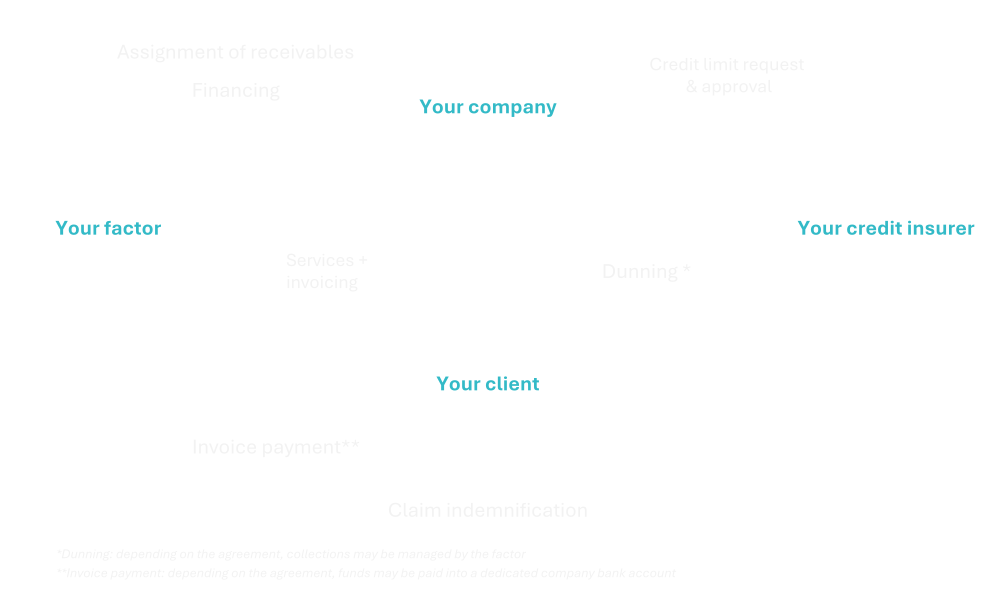
It also enables SMEs to outsource receivables management (reconciliation, collection, dunning and recovery), reducing operational burden while limiting the risk of delays and defaults.
As an asset-based financing solution, it helps manage seasonality and respond to short-term cash needs, making it a highly effective treasury management tool.
Mid-sized companies (growth-stage)
Your needs as a mid-sized company:
- Access financing that adapts to each stage of growth
- Secure funding for ongoing operations
- Finance external growth and organic expansion
- Support international development
- Complement existing bank facilities
Key benefits:
- Rapid mobilisation of up to 95% of receivables, without waiting for maturity
- Stable and sustainable liquidity, backed by trade receivables
- Access to confidential receivables financing structures
- Optimisation of financial ratios through off-balance sheet mechanisms (IFRS and local GAAP compliant)
- Fast implementation (typically 1 to 3 months)
- Cash centralisation capabilities
- Resilience to changes in shareholding
Focus: supporting growth and international expansion
As your business expands domestically and internationally, receivables financing becomes a scalable funding solution.
Selecting a financing partner capable of supporting new jurisdictions allows you to anticipate funding needs. Each new subsidiary requires resizing of facilities, extension of credit risk coverage, credit approvals and technical implementation.
Receivables financing thus becomes a core component of a global funding strategy, enabling smoother cash flows without increasing balance sheet leverage.
International groups
For international groups—often multi-entity and multi-currency—receivables financing becomes a sophisticated financial engineering tool. It serves as a cash centralisation instrument for group finance teams. Fibus has supported international groups across more than 40 countries.
Your needs as an international group:
- Secure reliable funding lines or improve financing terms
- Refinance part or all of existing debt
- Optimise the balance sheet through off-balance sheet structures
- Finance both organic and external growth
Key benefits:
- Deployment of pan-European or multi-jurisdictional programmes, with committed facilities of up to five years
- Off-balance sheet treatment under IFRS, French GAAP and US GAAP
- Confidentiality of receivables assignments
- Resilience to changes in ownership
- Harmonisation of receivables management practices across subsidiaries, with centralised oversight
- Reduced reliance on external financing in tightening credit environments
- Enhanced resilience through funding directly linked to operating activity
- Synergies with credit insurance, securitisation and reverse factoring within integrated cash management programmes
Focus: a group-level financing strategy
For multi-country groups, receivables financing programmes must be fully tailored to optimise liquidity.
A group-level approach enables greater funding efficiency, economies of scale and operational gains. Receivables financing can also be integrated into broader digital transformation or IT harmonisation initiatives (ERP, TMS), with real-time data flows and consolidated dashboards to enhance working capital management at group level.