

About the Interviewees
Thibaut Robet co-founded Fibus (formerly Chateaudun Crédit) with Gaëtan du Halgouët in 2006. Fibus has made factoring advisory for Private Equity funds its core specialization: today, 4 out of 5 transactions led by Fibus support companies operating under LBO structures. Having joined Fibus in 2018, Maxime Bertin now serves as Deputy CEO in charge of Fibus Factoring.
Factoring continues to strengthen its position within the Private Equity ecosystem: from Small Cap to Large Cap, factoring solutions support shareholders throughout every stage of their portfolio companies’ growth strategies.
Could you briefly explain what factoring is?
Thibaut Robet: In simple terms, factoring means converting two months of revenue into immediate cash. It is a short-term financing solution dedicated to B2B companies. It relies on the company’s trade receivables – more specifically, on customer payment terms. Factoring enables companies to receive payment within one or two days instead of waiting until invoice maturity.
Maxime Bertin: Let’s take two examples. For a company generating €60 million in revenue, factoring can represent around €10 million in financing capacity. At another scale, a company with €3 billion in revenue could unlock as much as €500 million through factoring – which is highly significant.
T.R.: In France, companies are generally paid within 60 days, hence the “two months” I referred to earlier – although payment terms can sometimes extend to 90 or even 120 days depending on the industry and the countries where clients are located.
“Factoring supports growth financing while securing portfolio companies’ liquidity.”
You have been advising Private Equity funds for more than 15 years. What are the advantages of factoring for funds compared with other financing solutions?
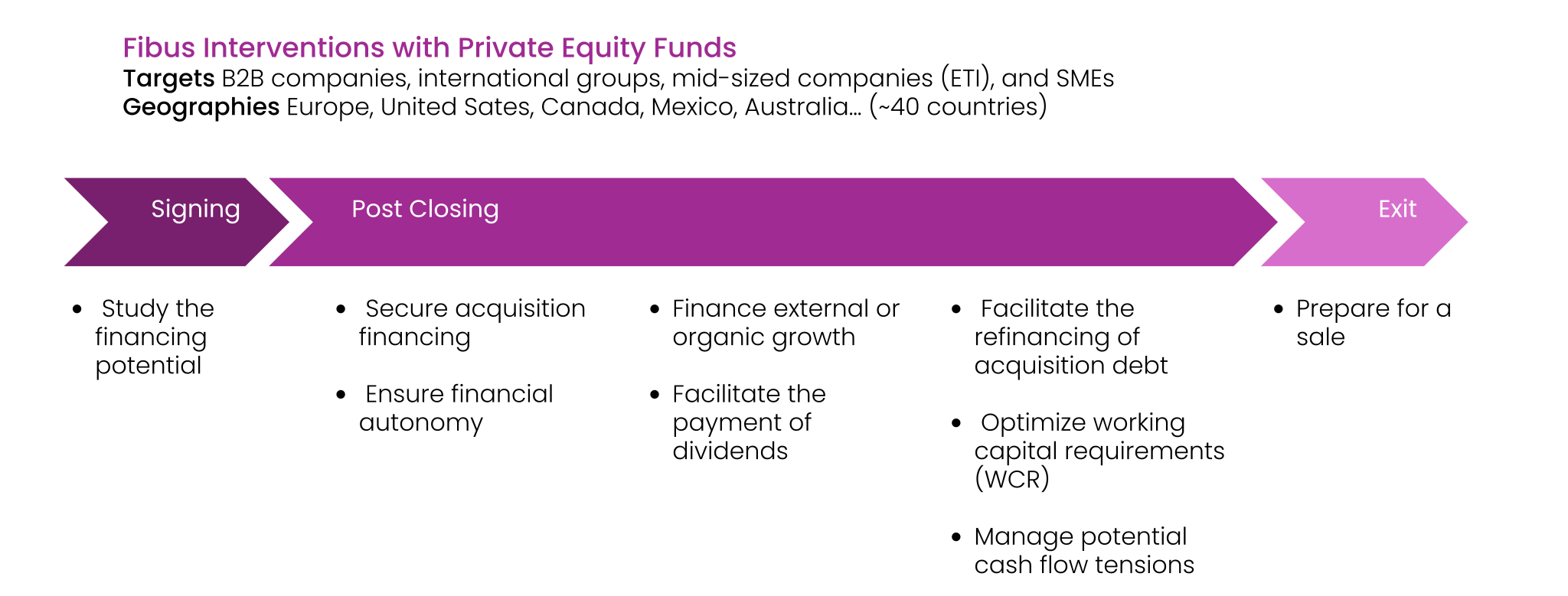
T.R.: Factoring is both fast to implement and off-balance-sheet: it allows funds to secure liquidity quickly for their portfolio companies. It is one of the most efficient financing tools available to support a company throughout its lifecycle. It can be activated at different stages, depending on what best serves the shareholder’s strategy.
M.B.: A fund may decide to implement factoring immediately after acquiring a portfolio company in order to secure the transaction. Over the longer term, it can also use factoring to finance organic or external growth, or to make the business cash self-sufficient. Factoring can also facilitate dividend upstreaming or refinance shareholder current accounts.
T.R.: Factoring is the lowest-cost financing solution available for LBO-backed companies. Margins above the benchmark rate typically range from 1.5% to 2%, making it significantly cheaper than debt, equity or an RCF. Compared with traditional overdraft facilities, it also provides substantially larger financing capacity. Another key advantage is its off-balance-sheet treatment, meaning it does not increase the company’s leverage ratio.
M.B.: Funds are also attracted by other features of factoring: confidentiality, as well as stability and flexibility. Agreements are generally signed for several years and automatically adapt to the company’s activity level, regardless of its growth phase.
Are there any “dos and don’ts” for successfully implementing a factoring program as an investment fund?
T.R.: Anticipation is critical. Planning a factoring program well in advance – even before signing an acquisition – gives you far greater flexibility and negotiating power than addressing the issue only once cash needs arise. It allows the financing to be triggered at the most relevant moment for the portfolio company, with full visibility to make the right strategic decisions.
“Factoring is a stable, off-balance-sheet financing solution.”
M.B.: This is exactly the purpose of our advisory work with funds: providing clear insight into the portion of revenue eligible for factoring, the amount of cash that can be generated, the expected cost for the company, and the appetite of factoring providers for the transaction.
T.R.: If anticipation is a “do,” my “don’t” would be: do not move forward alone. Implementing a factoring structure is highly transformative for a company – which is positive, but also time-consuming.
“Our mission is to simplify and accelerate the implementation of factoring programs.”
The order-to-cash chain must be optimized, customer knowledge must be highly granular, and Finance teams need to be involved at every level. Around 80% of our support takes place operationally, before and after negotiations with factors themselves.
M.B.: Our role is to simplify and accelerate the deployment of factoring programs. Our in-depth knowledge of French and European factors enables our clients to save significant time: we understand each lender’s expectations, procedures and requirements, and we know how to prepare teams for both implementation and ongoing management.
T.R.: Over the past few months, we have also observed a rise in syndications between factors, which increasingly seek to share risk on large-scale programs. This naturally adds complexity to deal structuring – and managing complexity is part of our DNA.
The Private Equity market experienced mixed conditions in 2023. What are you observing in mid-2024 from your position as financing advisors?
M.B.: In 2023, we saw strong activity in Small and Mid Cap deals, while Large Cap transactions slowed down. As a result, we were less frequently engaged on acquisition-related financing programs. However, funds asked us to review their portfolios in order to optimize liquidity across their holdings, particularly among Large Caps, both in France and internationally. In Q1 2024, we observed a strong rebound in deal volume, especially in Mid Cap: transactions may be smaller in value, but they are more numerous. Today, acquisition-related activity has clearly picked up again.
T.R.: This demonstrates that Private Equity players increasingly understand the full range of opportunities offered by factoring: optimizing portfolio performance, supporting growth, or enhancing valuation ahead of an exit. It is an extremely powerful financing tool.
Key Facts
- Fibus employs 60 specialists across three complementary divisions: factoring, credit insurance and dedicated digital solutions.
- Fibus is now the leading factoring advisory firm in both France and Europe.
- In 2023, Fibus supported clients across 37 countries and generated more than 50% of its business internationally.
- Fibus operates offices in France (Paris, Reims, Lyon and Poitiers) as well as in London.
- In 2023, Fibus launched ARI Trade, a software platform designed to centralize and manage both factoring and credit insurance within a single interface.
Source: Décideurs Magazine